
The Humanist
Mixed Feelings, Honest Feelings: My Take on Nolan's The Odyssey
Last night I watched Nolan's Odyssey at the cinema, and here is my take and a few reflections.
Last night I watched The Odyssey at Alee Cinema in Budapest, with dear friends, and I'll admit it upfront: I was one of the reasons the group's verdict landed as "mixed."
But mixed doesn't mean negative. It means the movie gave me a lot to chew on.
A Stellar Cast That Earns the Word
Let's start with what's undeniable: this is a stellar cast, and every one of them earns that adjective. Nothing here felt like stunt casting: the performances carried real weight, and it showed in every scene.
Where My Biases Got Confirmed
That said, the film confirmed a bias I walked in with: this is a Hollywood movie, and it leans harder into sensation and action than into emotional depth. I missed curiosity and the fascination for mystery as a driving force which for me it's one of Odysseus's most defining traits, his polymetis nature, the "man of many turns" whose hunger to know is as central as his hunger to return home. I recognize this is a personal lens more than an objective flaw, but it's the thread I kept reaching for and not quite finding.
The Changes That Didn't Hurt, and the One I Missed
A few changes from the poem made it into the film, and honestly, none of them wounded me. The episode with young Nausicaa and her first stirring of feeling for the stranger who washed up on her island — Odysseus — followed by the storyteller singing the fall of Troy in front of her parents' court, the moment Odysseus breaks down and reveals who he is, and only then begins recounting everything he's been through: that sequence in the poem is something I've always loved.
The film swaps some of it for a memory-recovery arc and a dialogue with Kalypso (played by Charlize, one of the living celebrities I have always admired and found among the most beautiful), and while it worked, it landed with less power than the original.
What I did miss immensely was the poem's sharper tension between immortality and divine status on one side, and the pull back toward mortal, human Ithaca on the other. That contrast is one of the emotional engines of the Odyssey, and the film softened it more than I expected.
The Women Stood Out. And That's the Real Achievement Here
If there's one thing this adaptation gets distinctly right, it's the female characters. The hints given to Penelope, Helen, Kirke, for me, the most interesting and distinctive part of the whole film. They weren't flattened into the tired "seduced and desperately in love with Odysseus" trope, and that restraint is worth celebrating.
I also appreciated the clear nod to the crimes of the "winners", sins committed by men who, even when nudged by the gods, overstepped what was licit and reached for godlike status themselves.
That's precisely why so many of them are punished with failed, tragic nostoi, the long, broken road home. It's one of the poem's core moral engines, and the film didn't shy away from it.
Poem, Book, Drama, Film: Different Channels, Equal Depth
One thing I'll push back on, as a general point: I don't buy the idea that some mediums are inherently shallower than others. Poems, books, dramas, and films are four different channels, and each of them is capable of triggering and conveying depth at the same level. What changes isn't the ceiling, it's the medium itself, its grammar, its tools.
The Odyssey on screen doesn't have to lose to The Odyssey on the page. It just has to speak its own language well.
Why This Story Keeps Showing Up in My Work Too
Watching this on screen, I couldn't help but see the same map I walk with clients in my Insights Discovery–led consultancy. The Odyssey is, at its core, a journey of self-awareness disguised as an adventure story, and that's exactly the terrain I work in.
Odysseus' nostos isn't just a trip across the sea: it's a slow, forced encounter with who he actually is once the armor of "hero of Troy" stops being useful. Every island strips something away or reveals something he'd rather not face: his cunning, his pride, his impatience, his longing for home.
That's the same arc I see in the 8 personality types and the 4 colour energies: people don't arrive at self-awareness by staying comfortable in their dominant preferred energy. They arrive by getting shipwrecked, metaphorically, on the parts of themselves they underuse.
That's a core Insights Discovery point: the colour energy isn't the whole story; what someone does with it is.
There's another layer to this that I think matters even more. Odysseus's journey isn't just his journey, it's the journey any of us walk every time we're called toward something new. A new role, a new relationship, a new version of ourselves we haven't met yet. And every time, the unknown takes on that same mythic, monstrous scale: Scylla and Charybdis, the Cyclops, the Sirens. These aren't just obstacles in a plot; they're what the unknown feels like from the inside, magnified by our own instinctive pull toward it and our terror of it at once, fascination and dread braided together.
Underneath both is the same root: fear of defeat, and beneath that, fear of disappearing altogether.
The monster is rarely the size we think it is. It's a matter of perception, how much of our own fear we've projected onto the shape in the dark.
Part of what I do with clients is exactly this: helping them see that the "monster" ahead of a new challenge is often their own fear wearing a costume, and that naming which energy they're avoiding (the Cool Blue caution, the Fiery Red confrontation, the Earth Green patience, the Sunshine Yellow leap) is usually enough to shrink it back down to size.
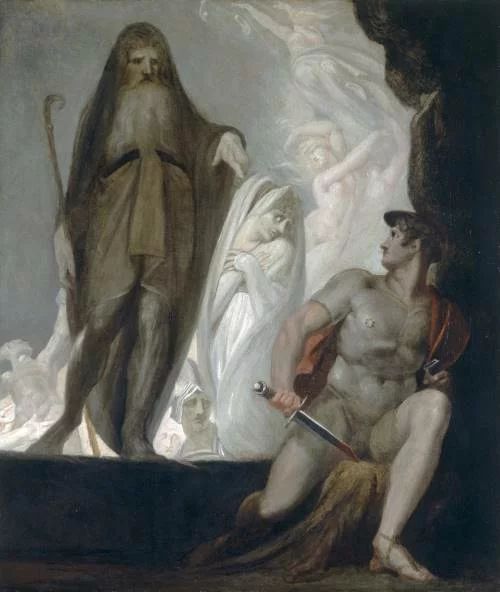
And here's the piece that ties it all together: Odysseus doesn't overcome any of this alone. Every real advance he makes comes from a gift handed to him by someone he meets along the way: Kalypso, who teaches him what it costs to stay too long inside comfort; Circe, who shows him what he becomes when he stops resisting his own appetites, and then hands him the way forward anyway; Tiresias and the dead in the underworld, who give him the one thing no living person on the journey could, a glimpse of his own future, and the terms of his own mortality. None of these gifts are weapons or shortcuts. They're all, in different forms, the same thing: awareness.
Each mentor doesn't fight the monster for him, they give him the seeing he needs to face it himself. That's precisely the role I try to play in a session: I'm not there to slay anyone's Scylla for them. I'm there to be the Circe or the Tiresias for an hour, handing over a piece of self-knowledge, a name for the energy they've been avoiding, a clearer look at the terms of their own journey, so they can walk back out and face the strait on their own terms.
The whole poem, really, is a 3,000-year-old argument for the idea I bring into every session: you don't discover who you are by staying on one island. You discover it by being tested across many, and by noticing which parts of yourself you reach for under pressure, and which parts you've been neglecting. Odysseus gets home not because he's the strongest in the room, but because he eventually learns when to be Fiery Red and charge, when to be Cool Blue and think, when to be Earth Green and endure, and when to be Sunshine Yellow and charm his way through. That range — not any single dominant energy — is what self-awareness actually looks like.
Verdict
Overall, I liked it. It's not the Odyssey of my imagination — my Odysseus is curious first, cunning second — but it's a handsome, well-acted retelling that finally gives its women room to be more than reflections of the hero.
Worth the big screen, worth the conversation with friends afterward, and worth every one of those mixed feelings.