
The Humanist
Walk My World: What Happens When You Take Off the Mask and Walk Into Chaos?
Last time I wrote about the persona, the mask we wear at work and in our social lives. This time I took mine off. Recirquel's Walk My World has no stage, no seats and no single story: only a labyrinth, a myth and the vertigo of choosing where to go.
Quick answer. When you take off the mask and walk into chaos, the first thing you feel is vertigo: no role to play, no goal to reach, no one telling you where to look. If you stay with it, the vertigo turns into attention. That is what happened to me at Walk My World, Recirquel's immersive show in Budapest: two and a half hours inside the myth of Dido and Aeneas, with no stage and no seat. Theatre has always offered this: a safe place to lose ourselves and feel what our roles keep out, which the Greeks called catharsis.
What is left of you when nobody has given you a part to play?
In my last article, Who Am I Beyond My Job Title?, I wrote about the persona: the mask we wear and embody in our social lives, and why it is worth noticing how sustainable the show is in the long run. This time I want to tell you what happened when I was invited to take mine off.

What is Walk My World?
Walk My World is an immersive show by Recirquel, the Budapest company known for contemporary circus and dance. It fills a 6,000-square-metre space built like a series of film sets. There is no stage and no seating area: you walk freely among the performers, like an invisible observer who has stepped into a film. The story, inspired by Virgil's Aeneid, is the tragic love of Dido and Aeneas, between Troy and Carthage. It unfolds along many threads at once, so each visitor follows a different path and puts together a different story.
It is a superb contamination of art, circus, dance and meaning. But for me it was not a show. It was a journey in many directions at the same time.
Why did it feel like Piranesi's prisons?
Giovanni Battista Piranesi etched his Carceri d'invenzione, the "Imaginary Prisons", around 1750 and reworked them in 1761. They are vast vaults where staircases lead nowhere, bridges cross into darkness and tiny figures climb towards exits they never reach. Every exit opens onto another room.
Walking through Walk My World felt like that. An archive with files piled to the ceiling. A red room crossed by neon. A pool of water that doubles a body. Corridors that open on a scene already in progress, which you leave before it ends. No map tells you what is "the" story. You are free, and freedom here is not comfortable.
What does chaos mean, really?
Socrates would start here: tì estì, what is it? In Hesiod's Theogony (line 116), the first thing that comes into being is Χάος (Cháos). It is not a mess. The word is related to the Greek verb for yawning or gaping: Chaos is a gap, an open space, the emptiness from which everything else can take shape. Ovid later imagined it as "a raw and formless mass" (Metamorphoses 1.7).
That is how I would describe the night. We were invited to "unwear" our masks and to be a kind of nihil, a nothing, in front of the whole experience: no expectations, no role, no plan. An empty space, ready for something to emerge.
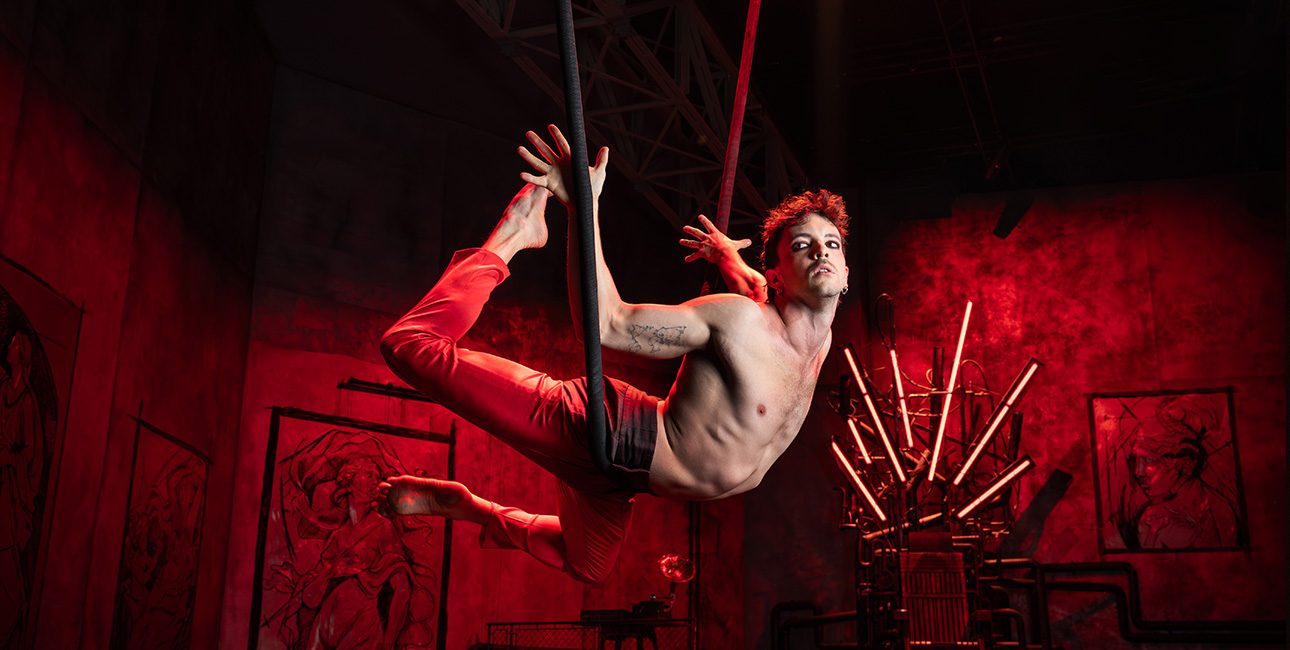
Why does losing yourself start with vertigo?
I have to confess: it was not an easy walk. At the beginning I felt a bit of vertigo. Where should I go? What am I missing? Am I in the right room? These are the questions of a mind that wants a goal, a role and a way to perform well, even as an audience.
Kierkegaard called anxiety "the dizziness of freedom" (The Concept of Anxiety, 1844). When every direction is open, the ground seems to move. Then something changed. I stopped fighting the vertigo and welcomed it. I welcomed the nothing: no goal, no right path, just feeling. Jung warned that when the persona falls away, the temptation is to rebuild it as fast as possible (The Relations between the Ego and the Unconscious, 1928). Staying in the gap a little longer is what lets something new come through.
What is catharsis, and why do we still need it?
Aristotle wrote that tragedy, through pity and fear, brings about the κάθαρσις (kátharsis) of these emotions (Poetics 1449b). Scholars still debate whether he meant a purification, a purging or a clarification. What I know is this: theatre has always been my obsession and my main interest, and it still is today, because it gives us a safe place to lose ourselves.
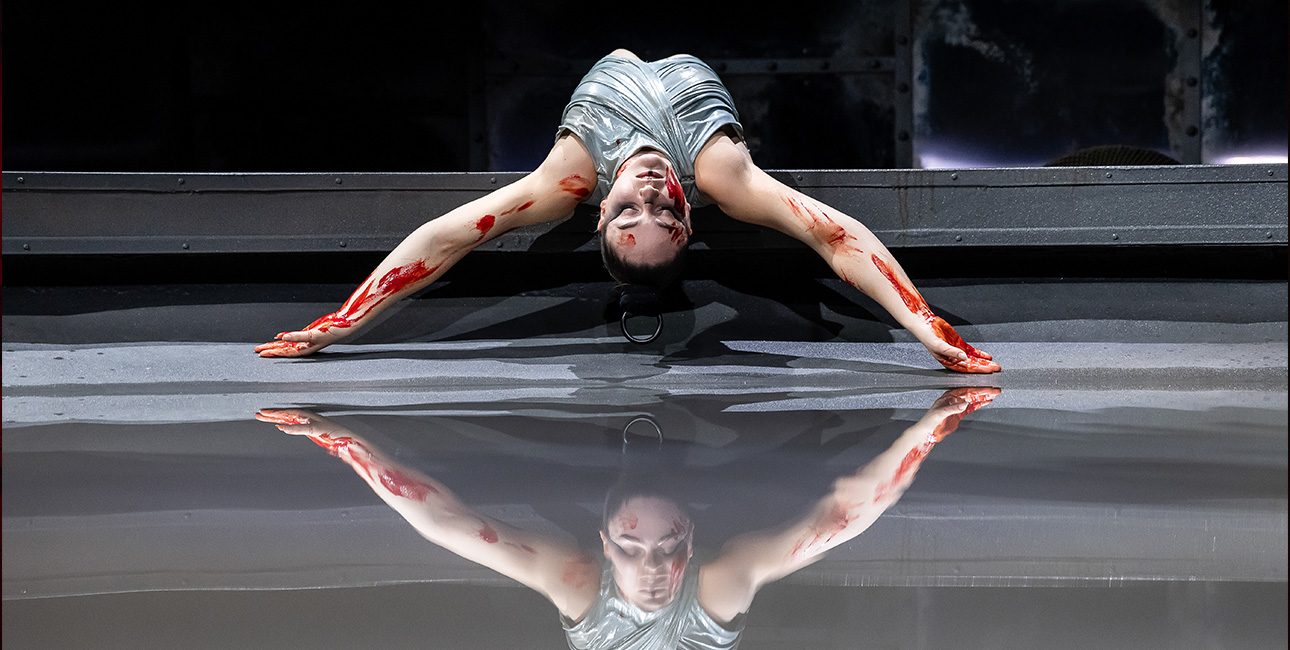
Losing ourselves to live passion, torment, luxury, greed, violence, grief, revenge, love, loyalty, betrayal and power. That is what I recall as the "emergence" of the night: not one story, but a whole spectrum of human experience rising out of the chaos, in no fixed order. Nietzsche put it better than anyone: "one must still have chaos in oneself to be able to give birth to a dancing star" (Thus Spoke Zarathustra, Prologue 5). In a show made of circus and dance, the line felt literal.
What does this have to do with work?
Every day we play role-games: the reliable colleague, the confident leader, the one who always has an answer. Those roles help us. But a life spent only inside them is a life where nothing is allowed to surprise us, including ourselves.
We need moments when we put the role-games aside and let our inner chaos come out. Not to stay in it forever, but to find out what is really there. Often what comes out is not disorder. It is energy we had stopped noticing: a passion, a grief, a desire, a strength.
Three questions to take with you
- When did you last do something with no goal at all?
- Which emotion does your daily role leave no room for?
- If you took off your mask for an evening, which direction would you walk in first?
There are no right answers, only your answer. If you want help decoding the gap between your mask and your mindset, the free profile on my site is a first step: about 40 minutes, in English or Italian, with a preview by email.
Take the free profile and decode your mask
Dido and Aeneas, one night later
The myth at the heart of Walk My World is the same one I will explore in my next reflective circle, A Night With… Dido and Aeneas, on Monday 2 November: a small group, one myth and an honest conversation about duty and passion, perception and the stories we tell ourselves. Find the details and book your free place on Eventbrite.
Related reading: Who Am I Beyond My Job Title? Jung's Persona and the Mask You Wear at Work
Photos: © Recirquel, from the show page of Walk My World.