The Humanist
The Glass Mask: Why the Masks We Wear at Work Are So Fragile
In The Glass Mask, an old actress warns her student that every role is a mask made of glass: hold it with total attention, or it shatters. What does that say about the masks we wear at work, and about what is left of us when one of them cracks?
Quick answer. A glass mask is a role you hold so carefully that one moment of distraction can break it. The image comes from The Glass Mask, Suzue Miuchi's manga about a young actress, known in Italy as Il grande sogno di Maya. At work we all wear masks: the calm leader, the always-available colleague, the newcomer who never asks. They help us adapt. They become fragile, and tiring, when they are held up from the outside instead of grown from the inside. Self-awareness is the skill of seeing your mask while you wear it, so you can choose it instead of being worn by it.
Discover your hero and your mask: free profile
When did you last feel one of your masks crack, in a meeting, a feedback talk or a bad day, and what did you see underneath?
What is The Glass Mask?
Garasu no Kamen, The Glass Mask, is a Japanese manga by Suzue Miuchi, first published in 1976 and still one of the best-loved stories about theatre ever drawn. Maya Kitajima is an ordinary girl with no money and no connections, but with an almost frightening gift: when she plays a role, she disappears into it. Her teacher is Chigusa Tsukikage, a legendary actress who guards the rights to a mythical play, The Crimson Goddess. Her rival is Ayumi Himekawa, talented, disciplined and born into a family of stars.
At the heart of the story is a warning from Tsukikage to her pupils. On stage, an actor wears a mask made of glass. It is transparent, so the audience sees a living face. It is fragile, so it holds only as long as the actor's concentration holds. One lapse, and the mask shatters in front of everyone.
In my reading, Maya is a modern mythological heroine. Like every hero, she leaves an ordinary world, meets a mentor, faces trials and a rival, and keeps walking towards a goal larger than herself. Her weapon is not a sword. It is a thousand masks, and the courage to put each one on completely. Anthropologists would say she lives in a long threshold, the liminal phase of a rite of passage: the time between a role you have left and one you have not yet become. Many of us live a promotion, a new team or a career change exactly there.
Why is the mask made of glass?
Socrates would start here: tì estì, what is it? A glass mask is a mask that does not hide. It shows the face through it, and its value depends entirely on the attention of the person who wears it.
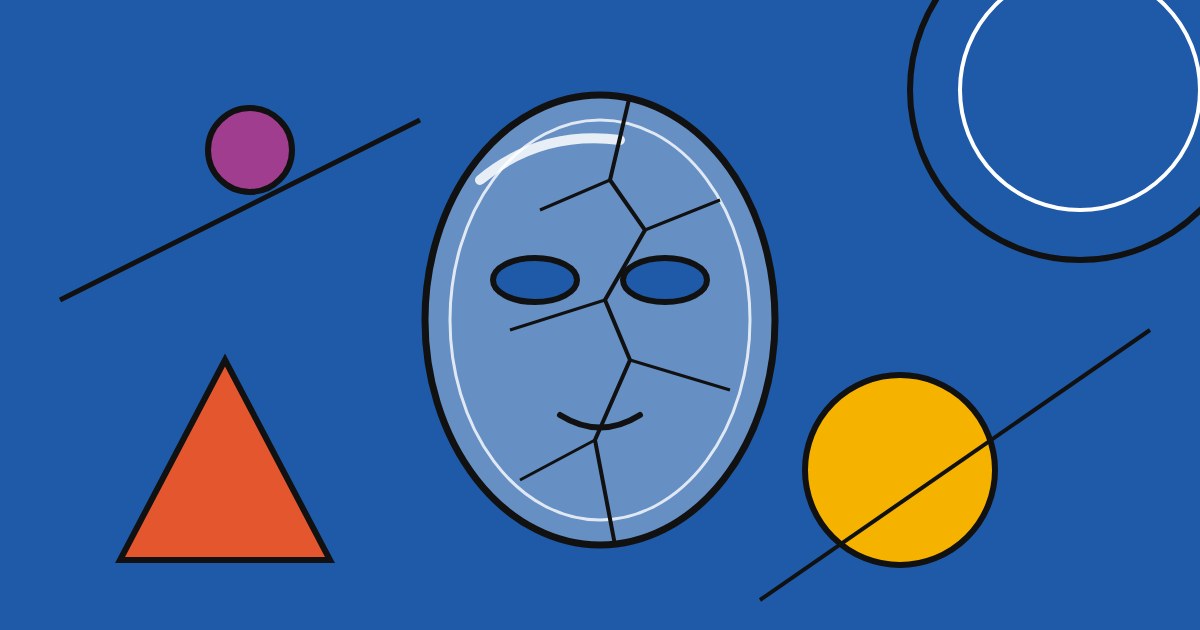
That is exactly how many of us live our roles at work. The mask is not a lie: it is how we meet clients, teams and managers. But some masks are made of wood, carved over years until they fit. Others are made of glass, held up minute by minute, and they crack under pressure: the reorganisation, the new boss, the first time we have to lead people we used to sit next to. Kandinsky, whose geometric style inspires the image of this article, wrote in Concerning the Spiritual in Art (1911) that form must follow "inner necessity". A mask that follows inner necessity is made of wood; one that follows only outer pressure is made of glass.
Research gives this a name. The sociologist Arlie Hochschild (The Managed Heart, 1983) called it emotional labour, and distinguished surface acting, showing an emotion you do not feel, from deep acting, trying to feel what the role asks of you. A meta-analysis of three decades of studies (Hülsheger and Schewe, Journal of Occupational Health Psychology, 2011) found surface acting consistently linked to emotional exhaustion. A glass mask, in other words, is a cost for workplace wellbeing long before it breaks.
What did the Greek mask do that a face cannot?
In Athenian tragedy the actor's mask, the prosōpon ("face"), was made of linen, cork or wood, and allowed a handful of actors to play every role in a play. It was sacred to Dionysus, the god who arrives as a stranger and turns the familiar upside down. The mask did something a face cannot do: it estranged. It put a distance between the spectator and the character, so that grief, rage or pride could be looked at instead of simply suffered. That distance is where catharsis begins. Sculpture keeps the same ambiguity: the gold funerary mask found by Heinrich Schliemann at Mycenae in 1876, now in the National Archaeological Museum of Athens, is still called the "Mask of Agamemnon", although it is centuries older than any Trojan War. A face that received a hero's name it never had.
The same estranging power returned in the twentieth century from an unexpected direction. In 1935 Bertolt Brecht saw the Chinese opera star Mei Lanfang perform in Moscow, without lights or scenery. The next year he wrote Alienation Effects in Chinese Acting: the performer who shows the character, and also shows that they are showing it, invites the audience to think, not only to feel. The Greek mask and the Chinese gesture meet in the same idea: we see a role clearly only when we can step a little outside it.
What do scholars of myth see in a mask?
Myth has never had one single version, and the scholars who study it remind us of that. Robert Graves, in The Greek Myths (1955), collected dozens of variants of each story side by side; his own interpretations are often speculative, but his lesson stands: a myth, like a person, is many stories at once.
Karl Kerényi, the Hungarian scholar who wrote Essays on a Science of Mythology (1941) with Jung, devoted a book to Dionysus (Dionysos: Archetypal Image of Indestructible Life, 1976). In the Dionysian cult the god could be worshipped as a mask hung on a pillar: the mask was not a disguise of the god, it was his presence. Georges Dumézil showed that Indo-European myths organise society around three functions, sovereignty, force and fertility (L'idéologie tripartite des Indo-Européens, 1958). Every community, ancient or corporate, assigns roles; the mask is the face that a function asks us to wear.
Arnold van Gennep (Les rites de passage, 1909) described the threshold between one role and the next, and Victor Turner later called its people "betwixt and between". In Italy, Giulio Guidorizzi (Il mito greco, 2009–2012) and Maurizio Bettini, founder of the Centre for Anthropology and the Ancient World at the University of Siena, have taught a generation to read myths as living cultural tools. Bettini and Ezio Pellizer's study of Narcissus (Il mito di Narciso, 2003) follows the most famous reflection in Western culture: a young man who mistakes an image for a person. A glass mask carries the same risk.
The mask is far older than Greece. The oldest known masks, carved in stone about 9,000 years ago, were found in the Judean Desert, at Nahal Hemar and nearby sites, and were shown together at the Israel Museum in 2014 (Face to Face: The Oldest Masks in the World). In Mesopotamia, clay plaques with the face of Humbaba, the forest guardian killed by Gilgamesh, were hung as protective faces; Thorkild Jacobsen (The Treasures of Darkness, 1976) and Andrew George, editor of the standard edition of the Epic of Gilgamesh (2003), show how much those societies thought through faces, images and divine presence. Further east, Mircea Eliade (Shamanism, 1951) described the masks and costumes with which Central and East Asian shamans cross into another world, and in China the nuo masked rites, studied for centuries as exorcism and theatre at once, still drive out what threatens a community. Kunio Komparu, a Noh actor and scholar (The Noh Theater: Principles and Perspectives, 1983), explains how the Japanese mask turns that ritual heritage into art.
In California, Pacifica Graduate Institute has built a whole programme in Mythological Studies around this braid of myth, anthropology and depth psychology, and keeps the archives of Joseph Campbell and James Hillman. Hillman's advice fits the glass mask perfectly: "stick to the image". Before explaining a mask, look at it.
What can Asian theatre teach us about gesture, costume and make-up?
Asian theatre treats every visible detail as language. Nothing is decoration.
- Noh (Japan). A Noh mask (omote) is carved with a neutral expression. The actor brings it to life with angle: tilting it slightly upwards, teru, "to shine", it seems to smile; tilting it downwards, kumoru, "to cloud over", it seems to grieve. Before going on stage, the performer sits in the kagami no ma, the mirror room, and looks at their reflection wearing the mask until they become the role.
- Kabuki (Japan). The kumadori make-up writes the character on the face: red lines for courage and passion, blue for coldness, jealousy or the supernatural. The audience reads the person before a single word is said.
- Peking opera (China). The painted faces, lianpu, follow a shared code: red for loyalty, black for integrity, white for cunning. Costume, sleeves and the way a fan is held complete the sentence.
At work we do the same, without noticing. A jacket, a tone of voice, the speed of an email reply, where we sit in a meeting: all of it is read by others as character. Communication in teams is never only words. The question is whether we know which signals we are sending. The art historian Ernst Gombrich explained why in his essay The Mask and the Face (1972): we recognise people first by their "mask", the overall expression we expect, and only later by their actual features, which is why a caricature can look more like someone than a photograph. With colleagues we do the same: we see the mask we expect, and miss the face that is changing.
The most precise lesson comes from Zeami, the great Noh master. In Kakyō (1424) he asks the actor to cultivate riken no ken, "the sight of detached seeing": to see oneself from outside, with the eyes of the audience, while performing. Six centuries later psychologists call this metacognition (John Flavell, American Psychologist, 1979): thinking about your own thinking, watching your own reactions while they happen.
Which mask are you wearing? Take the free test
One, no one and a hundred thousand masks?
Luigi Pirandello took the mask off the stage and put it into everyday life. In One, No One and One Hundred Thousand (1926), Vitangelo Moscarda is looking in the mirror when his wife remarks that his nose leans to the right. He had never noticed. From that small detail his certainty collapses: if others see a Moscarda he does not know, then he is not one person but a hundred thousand, one for each pair of eyes, and perhaps no one at all. Pirandello gave his collected plays a telling title: Maschere nude, Naked Masks. In painting, James Ensor had already given the idea a face: his Self-Portrait with Masks (1899) shows the artist surrounded by a crowd of grinning carnival masks, the only real face in the picture and the loneliest.
Maya, the girl of a thousand masks, could be Moscarda's opposite. She does not fear multiplying. She chooses each mask, wears it completely and knows she can take it off. The difference between the two is not the number of masks. It is awareness.
When does a mask become bad faith?
Jean-Paul Sartre offers the existentialist version of the same question. In Being and Nothingness (1943) he describes a café waiter whose movements are a little too precise, a little too eager: he is playing at being a waiter. Sartre calls it bad faith when we pretend that the role decides for us, as if we had no choice.
A glass mask can go either way. Worn consciously, it is adaptation: a skill, often a generous one. Worn as if it were destiny ("this is just how a manager has to be"), it becomes a hiding place. The existentialist question is simple and uncomfortable: who chose this mask, you or the role?
Nietzsche saw the other side of the coin: "everything that is profound loves the mask" (Beyond Good and Evil, § 40). A mask can also protect what is still growing. The point is not to tear it off, but to know what it is guarding.
Why do we need others to see our own mask?
In Plato's Alcibiades I (132d–133c), Socrates explains the Delphic "know thyself" with an image. An eye cannot see itself, but it can see itself reflected in the pupil of another eye. In the same way, a soul comes to know itself by looking into another soul.
This is why self-awareness is never a solo exercise. Feedback, a trusted colleague, a team that dares to say "you seem different when the director is in the room": these are the other eye. Emotional intelligence at work, in Daniel Goleman's terms, starts from self-awareness and grows in relationships. Research by the organisational psychologist Tasha Eurich (Harvard Business Review, 2018) suggests that while about 95% of people believe they are self-aware, only 10–15% actually are. The gap is precisely the mask we cannot see on our own face.
What do Jung and Insights Discovery add?
Carl Jung called the role we play for others the persona, from the Latin word for the actor's mask (The Relations between the Ego and the Unconscious, 1928; Collected Works 7, §§ 243–253). The persona is necessary. The risk is identification: forgetting that it is a mask, and losing touch with what lies beneath. Ingmar Bergman put this risk on screen in Persona (1966): an actress stops speaking in the middle of a performance of Electra, and her face and her nurse's slowly merge, until we no longer know whose mask is whose.
Insights Discovery®, inspired by Jung's psychological types (Collected Works 6), gives this a practical language. An Insights profile distinguishes a Conscious Persona, how you believe you need to behave in your current environment, from a Less Conscious Persona, your more instinctive preferences. When the two are close, the mask is made of wood: it fits. When they are far apart, you may be holding a glass mask, every day, with a precision that costs energy.
The four colour energies help to read the shift as qualities, not as labels. A role may ask for more Fiery Red decisiveness, more Cool Blue precision, more Sunshine Yellow enthusiasm or more Earth Green patience than you would naturally bring. None of these is better. The question is how much of your potential the mask lets through, and how much it blocks.
Three questions to take with you
- Which of your masks at work is made of wood, and which one is made of glass?
- When your mask cracked last time, what did people around you see: a weakness, or a person?
- Who is the "other eye" in your team, the person who helps you see your own mask?
There are no right answers. There is only yours, and noticing it is already a step from being worn by a role to choosing it.
One small action for this week: before an important meeting, take ten seconds of riken no ken. Ask yourself which mask you are about to put on, and why. A sign that something is shifting: you start noticing the mask while you wear it, not only afterwards, when you are tired.
Frequently asked questions
Is wearing a mask at work inauthentic? Not in itself. Adapting to a role is a social skill. Authenticity is not the absence of masks: it is knowing which mask you are wearing, why, and at what cost.
How can a team talk about masks without making it personal? By using a shared, neutral language. Mythological figures and the Insights Discovery colour energies describe styles and tendencies, not verdicts on people, so a team can talk about adaptation, collaboration and communication without anyone feeling judged.
Which heroes live in you, and which masks do you wear?
Every month on The Humanist I explore one hero, one myth and one mask. If you want to start from your own, the free profile on my site is the first step: in about 40 minutes, in English or Italian, you receive by email two mythological portraits, the hero of the way you think and the mask you may be wearing at work. They are editorial archetypes for reflection, not clinical categories. If the two figures differ, you have found your glass mask.
Take the free test: discover the heroes in you and the masks you wear
Related reading: Who Am I Beyond My Job Title? Jung's Persona and the Mask You Wear at Work · Walk My World: What Happens When You Take Off the Mask and Walk Into Chaos?